This playlist from our April 2016 issue is music to accompany puddle-splashing and shower-dodging. Plus, some cheery tunes for sunny intervals and bright sunshine days.
More from our current issue…
Featured
Blog
Taking Time to Live Well
This playlist from our April 2016 issue is music to accompany puddle-splashing and shower-dodging. Plus, some cheery tunes for sunny intervals and bright sunshine days.
Image: Lottie Storey/Oyster and Pearl
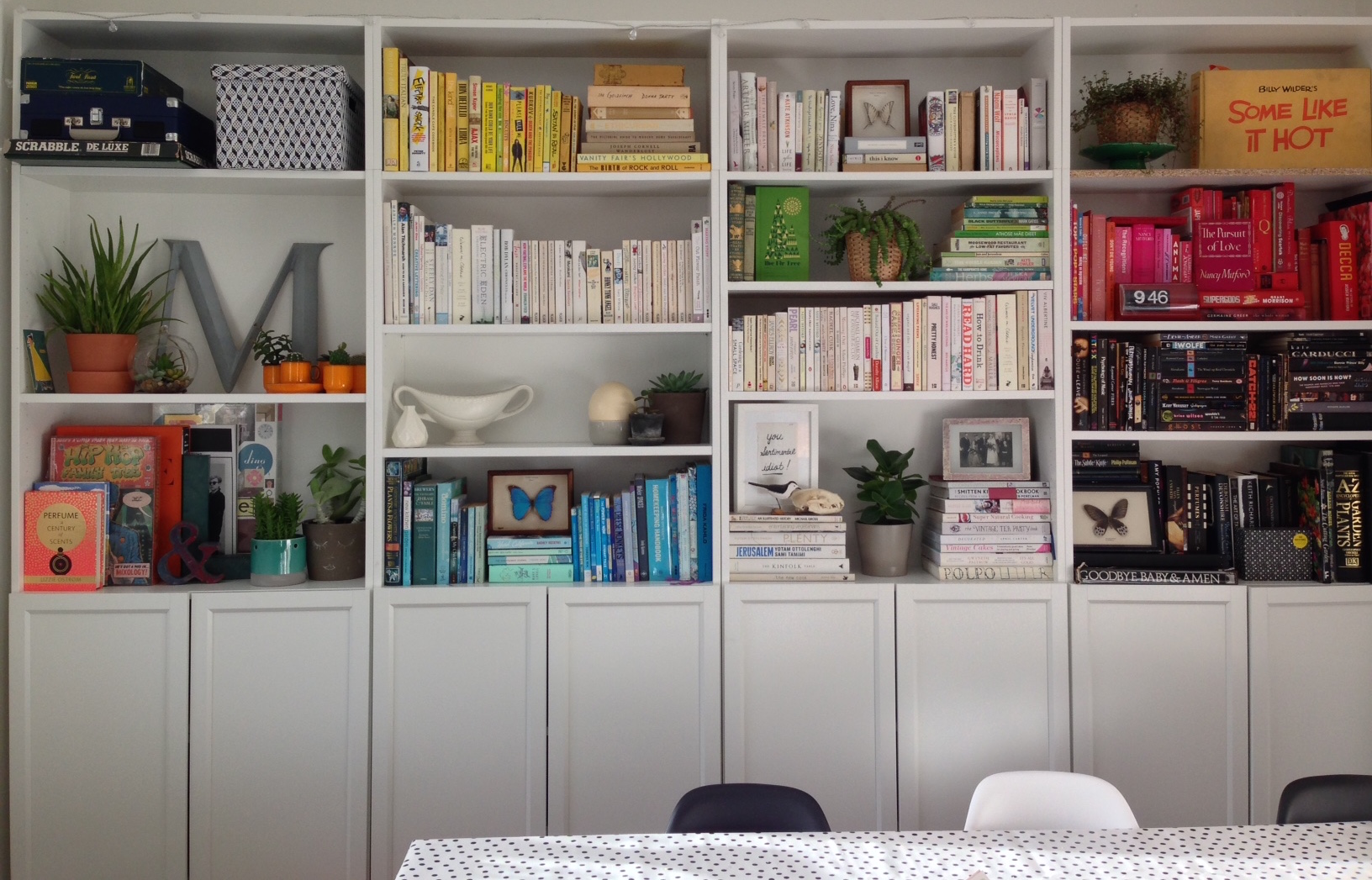
We’ve teamed up with The Folio Society, publishers of illustrated editions of the world’s greatest literature, to offer one reader a book of their choice* every month for a year. To enter, tweet, instagram or upload a pic of your bookshelf and give us your details below.
The Folio Society publishes an extensive range of fiction and non-fiction, so the only problem the winner will face will be which of the titles to choose each month. Selected from the best-loved books in literature, each Folio edition is produced with careful attention to detail and high production values.
* The winner will receive a single Folio book each month, worth up to the value of £50. Closing date: 13 May 2016. UK residents only. For full terms and conditions, see icebergpress.co.uk/comprules
Visit foliosociety.com to find out more and browse its titles.
Sign up to our fortnightly newsletter for regular competitions and offers
THE WOOL ROOM IS GIVING AWAY THREE LUXURY SETS OF DUVET, PILLOWS AND MATTRESS PROTECTOR, FOR A WARM, COSY, HEALTHIER SNOOZE
You’ll never need to count sheep again when you can drift off in your own wool cocoon. The Wool Room, the UK’s leading provider of British wool beds and bedding, is offering readers the chance to win one of three sets of wool duvet, mattress protector and pillows, worth almost £500 each.
Wool does so much more than keep you warm – this amazing natural fibre guarantees a better night’s sleep than with synthetic bedding as it regulates moisture levels, heat and humidity as we sleep.
The Wool Room has also developed its wool bedding to make it machine washable, so you can have both luxury and practicality.
The Wool Room’s bedding is approved by Allergy UK as being effective at eliminating house dust mites and other allergens, making it a great choice for asthma and eczema sufferers. It’s also much more breathable than other natural fibres.
Cocooning yourself with a wool duvet, mattress protector and pillow, then adding a wool mattress or bed for ultimate cosiness, makes for the most comfortable night’s sleep, according to The Wool Room. So confident are they you’ll love it, there’s even a free no-quibble 30-day sleep guarantee for any bedding set bought.
Each Custom Deluxe Bedding Set includes a duvet, mattress protector and pillows in the weight/size of your choice.
For more about wool bedding, visit thewoolroom.com.
Closing date 16 May. For full T&Cs, see icebergpress.co.uk/comprules.
Sign up to our fortnightly newsletter for regular competitions and offers
Photograph: Getty Images
Taking time for quiet doesn’t mean taking a vow of silence or sitting alone on a mountain (though those can work, too). Here are some tips for peaceful living...
l In conversation, don’t just prepare what you’re going to say next. Pay attention to the other person and speak into the spaces. Don’t be afraid of pauses in conversation.
l During moments of waiting, don’t immediately reach for your phone or book. Take a few minutes just to observe what’s going on around you.
l Allocate areas in your home for space, where little is displayed. A blank wall painted in a calming colour; a shelf with just one item on it. This helps promote a sense of quiet calm.
l Enjoy quiet time together. Instead of turning on the TV or music, spend some time with your family reading, or doing the crossword, a jigsaw or another quiet activity.
Turn to page 96 of March’s The Simple Things to read Loma-Ann Marks’ feature on how to seek out peace in a busy, loud world.
Why being alone can be good for you
The alarm clock is hard to love. It’s what startles you from the deepest of sleeps and jangles you into the day. It’s persistent and bossy, and won’t be silenced until you pay it attention. And the most annoying thing of all is that it does all of this for your own benefit, like a finger-wagging head mistress.
In an ideal world, of course, we would be woken naturally by the gentle caress of dawn and the soft rays of sunlight streaming through muslin curtains. But the reality is that it is more usual to be jumpstarted into the new day by the insistent clamour coming from the bedside table.
Turn to page 108 of March's The Simple Things to read the rest of Clare Gogerty's alarm clock potted history, plus her selection of the three best alarm clock buys.
And while we're moaning about mornings, here are our top picks for making early hours more bearable.
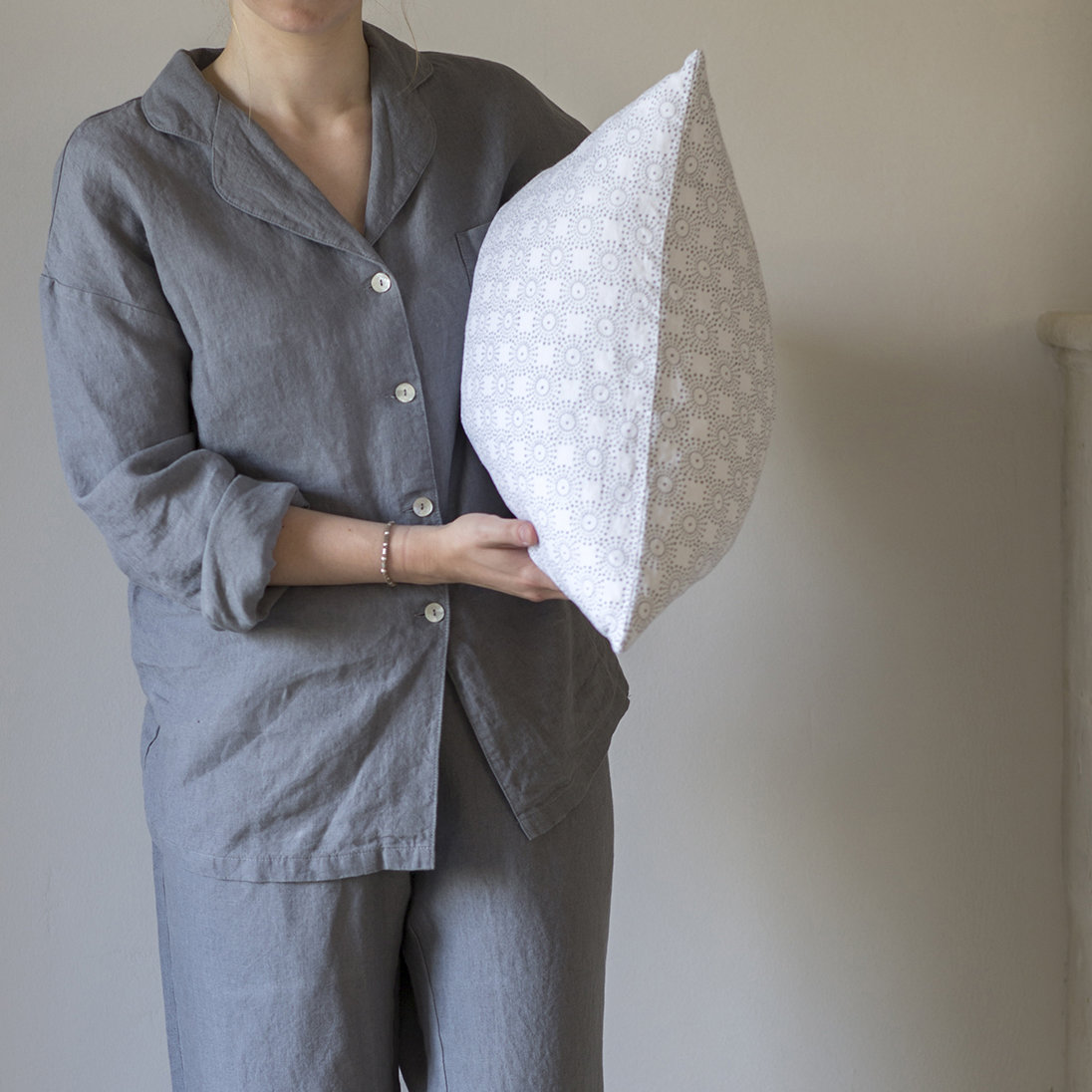
Linen pyjamas | The Simple Things Shop
Dressing gown | Verry Kerry
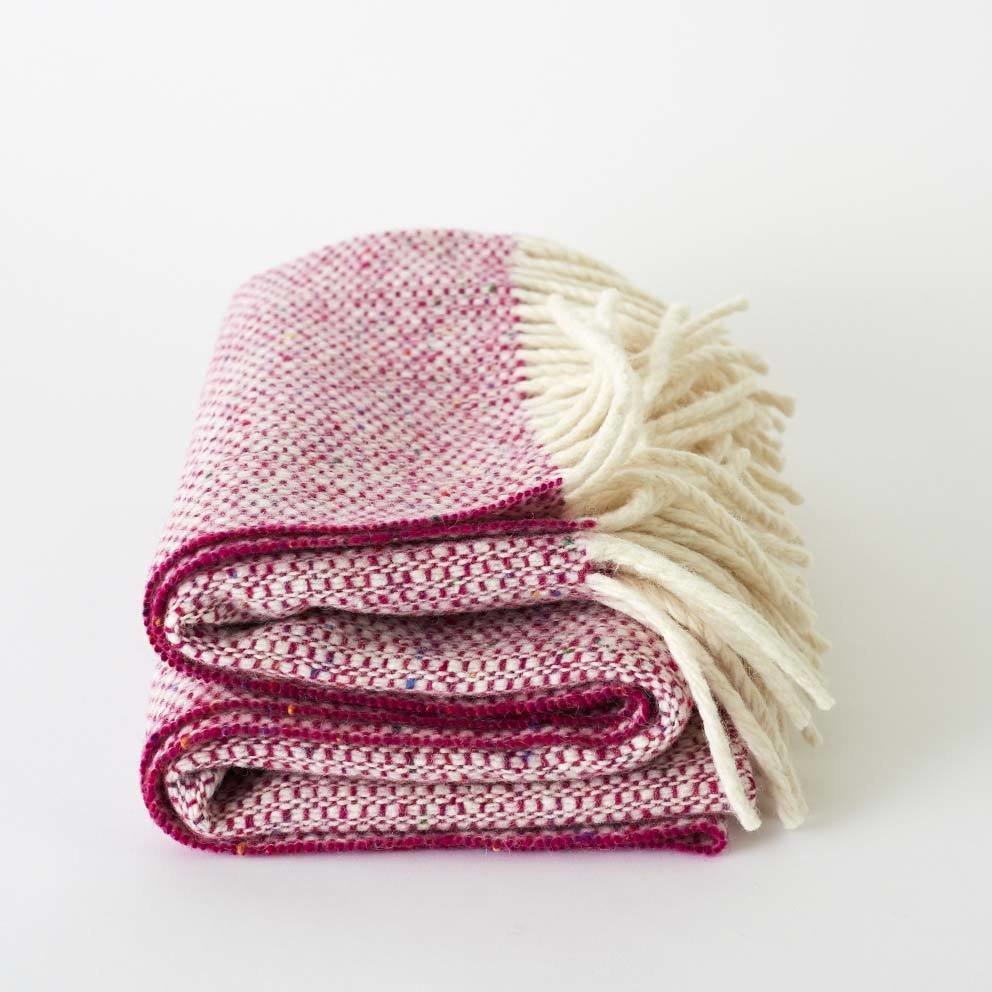
Blanket | The Simple Things Shop
Finally we are beginning to see signs that spring is on its way. Daffodils, blossom, Easter eggs and, dare we say it, the odd sunny day.
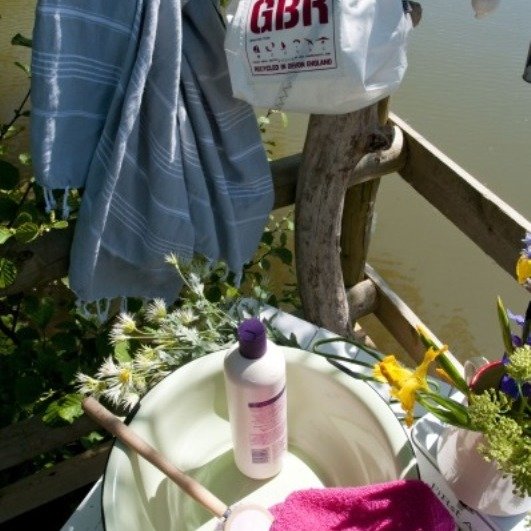
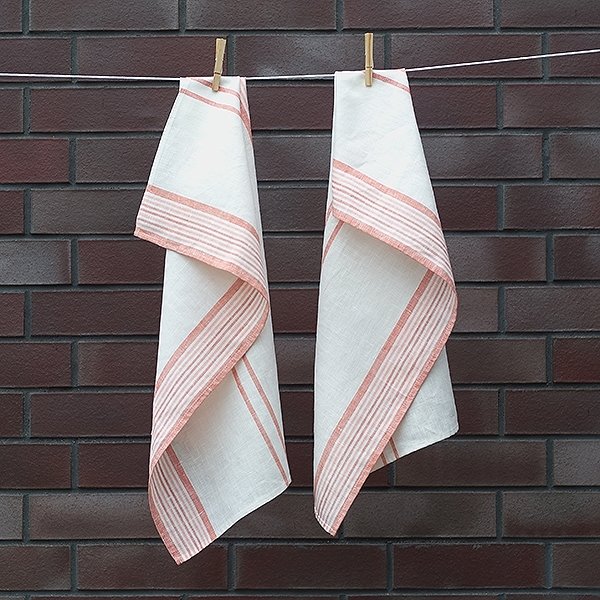
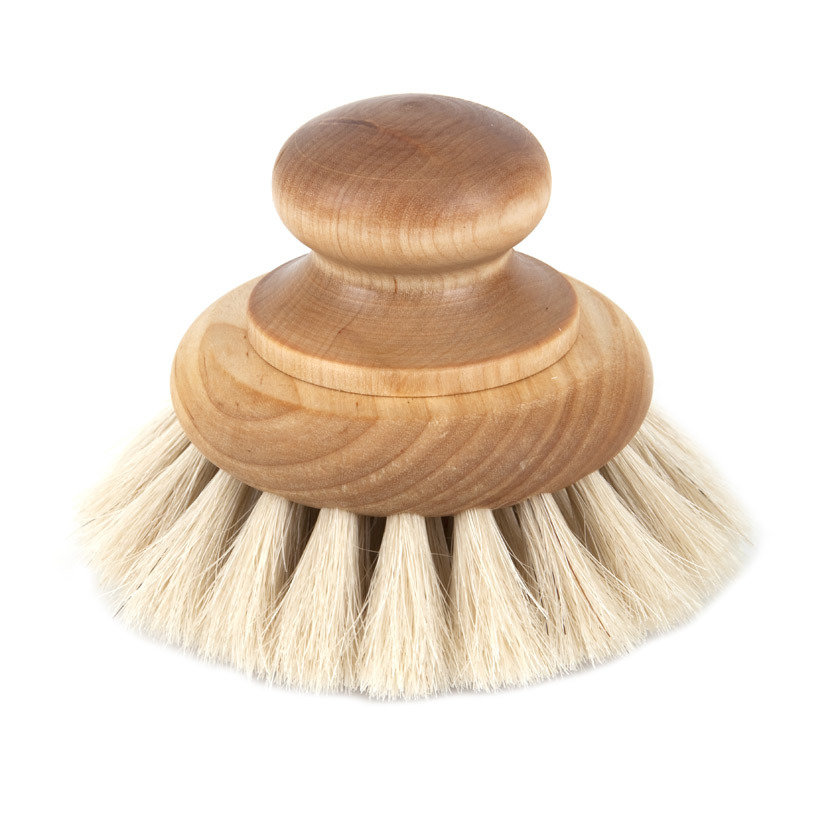
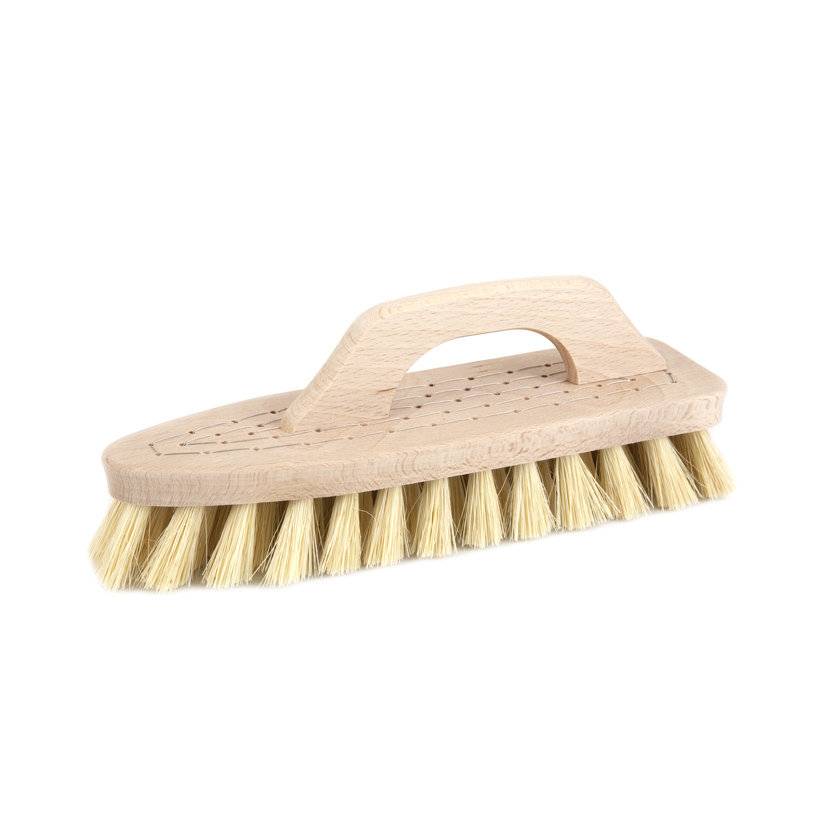
While it might not be time to put away our winter coats just yet, it is time to think about welcoming the new season into our homes. What better way to do so than with a spring clean. Whether you plan to set aside an entire weekend to clean from skirting board to ceiling or you’re just going to resolve to give those curtains a spin in the washing machine, our Shopkeeper, Louise Gorrod, has the selected the perfect cleaning kit from The Stuff of Life to make those chores a little more enjoyable.
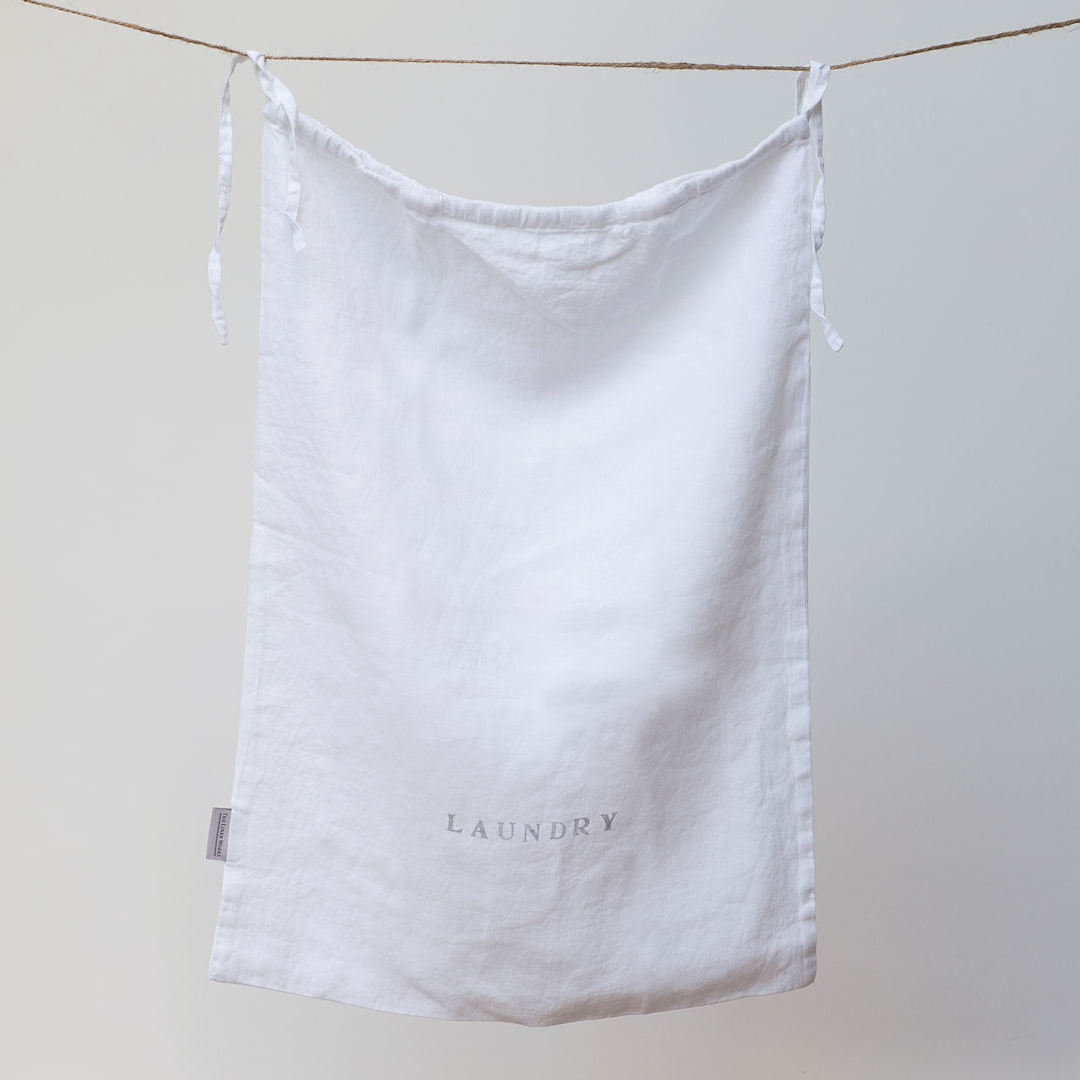
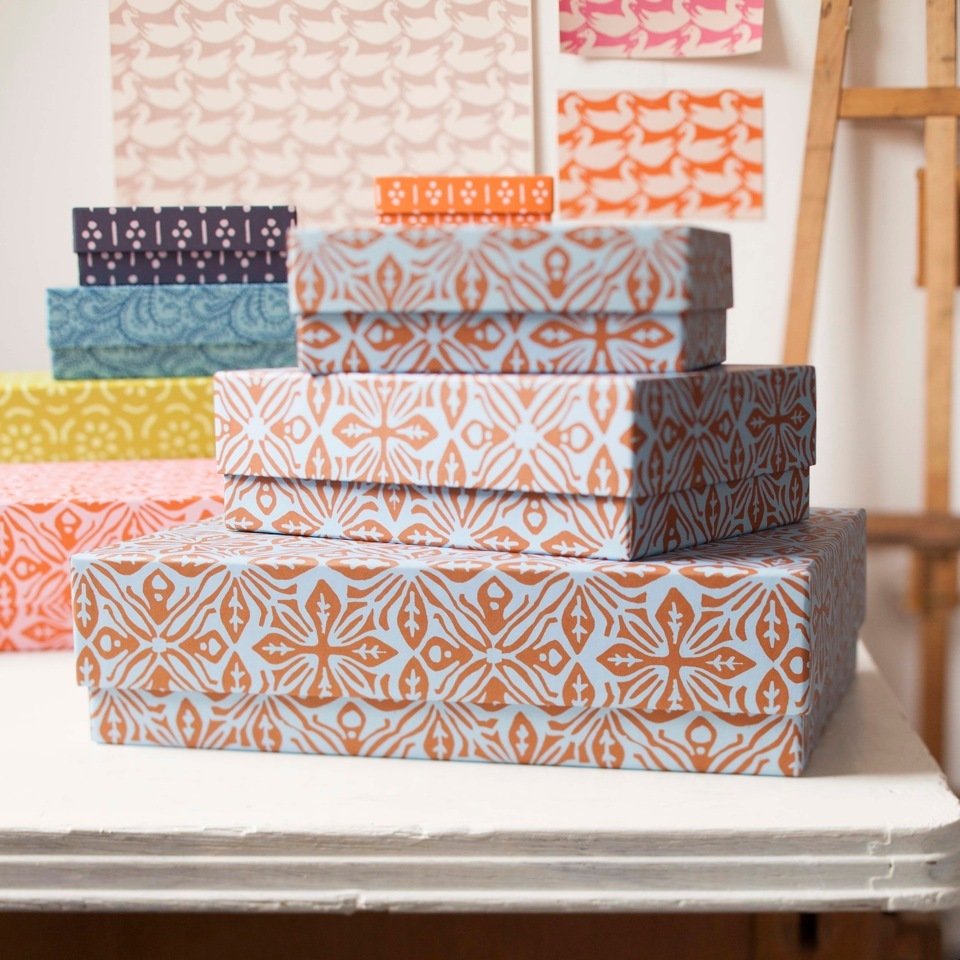
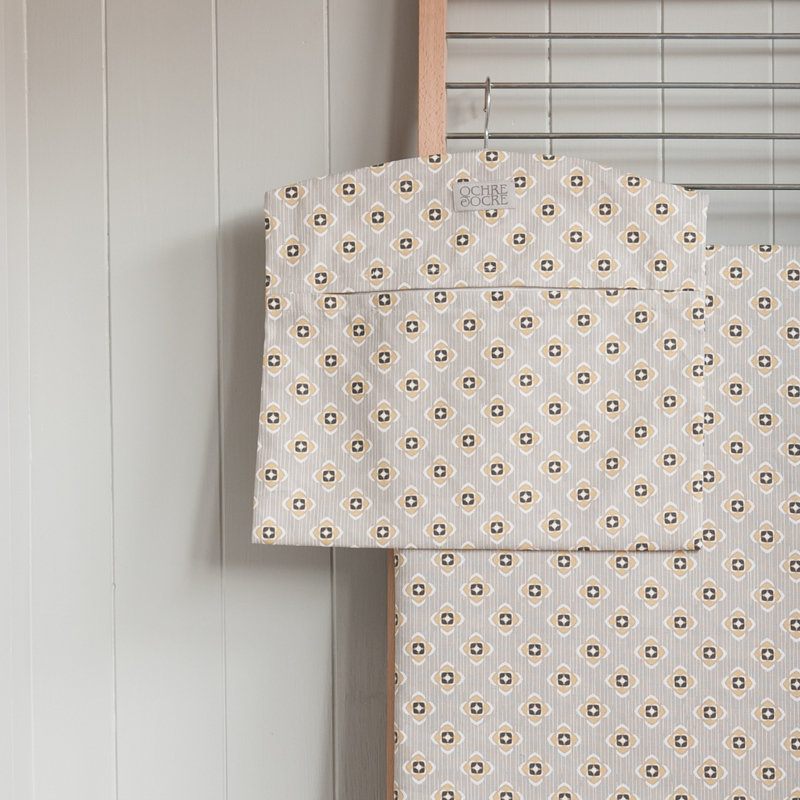
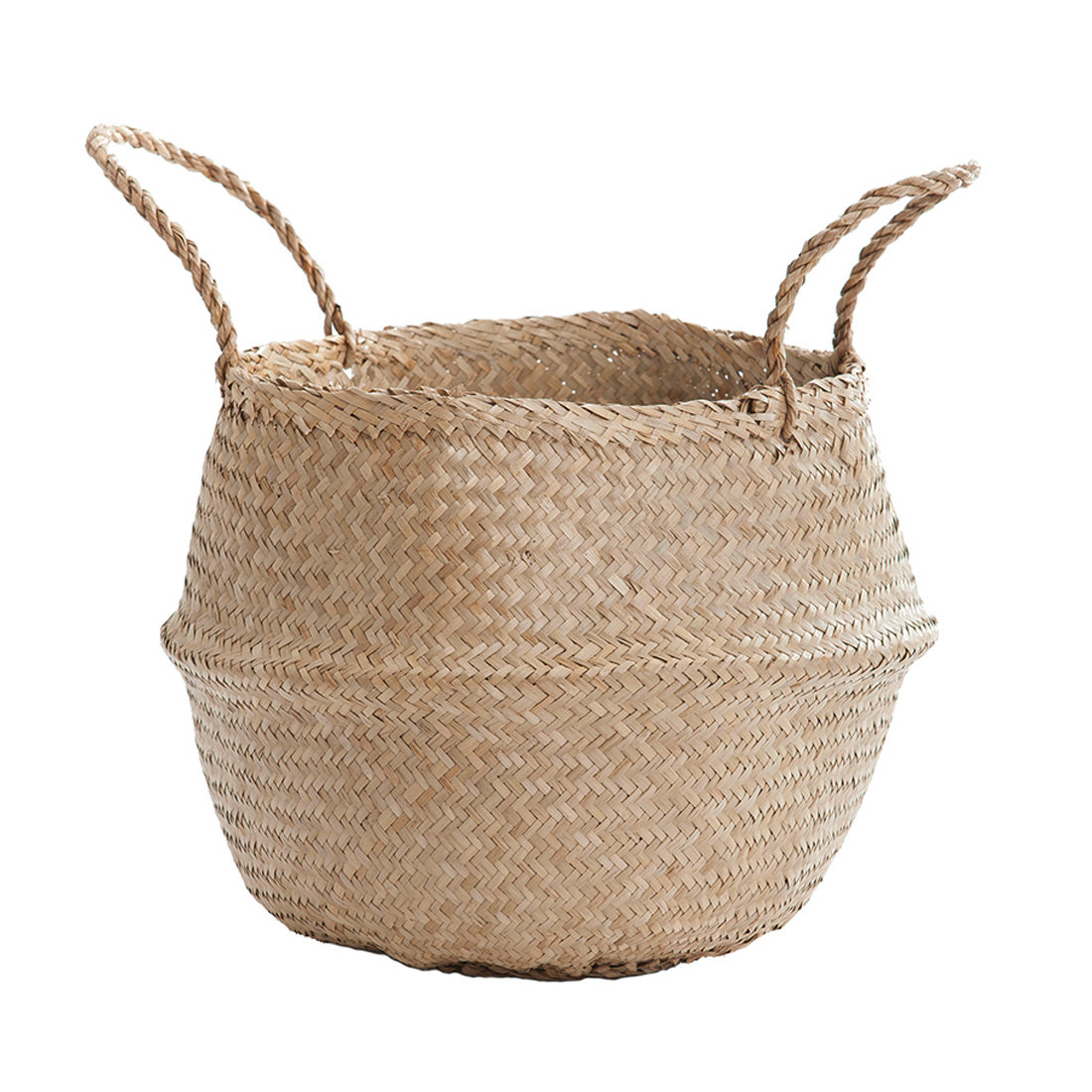
Images from top, left to right: Organic cotton ironing board cover by Orche and Ocre, £18.00 | Linen laundry bag by The Linen Works, £28.00 | Vintage style enamel wash bowl by The Glam Camping Company, £9.99 | Linen kitchen towels by LinenMe, £10.99 | Birch wood round brush by Cachette, £20.00 | Handcrafted scrubbing brush by Cachette, £12.00 | Set of 3 Kaleidoscope storage boxes by Cambridge Imprint, £18.00 | Organic cotton peg bag by Orche and Ocre, £12.00 | Natural belly basket by Olli Ella, £25.00.
If you toss and turn, are kept awake by tomorrow’s to-do list or are troubled by bad dreams, this aromatic herb pouch will help encourage a lovely, floaty, restful sleep.
Things you’ll need
3 tsp chamomile flowers
3 tsp peppermint
3 tsp sage
3 tsp valerian
3 tsp thyme
small piece of cotton fabric piece of string
..not a single sheep!
1 Place the ingredients in the centre of your piece of fabric and fold the corners in, so the herbs sit like the stuffing inside a cushion. Secure with string and place inside your pillowcase or next to it.
2 This is the last in our series of traditional Alpine remedies. To discover more, get a copy of Vinegar Socks by Karin Berndl & Nici Hofer (Hardie Grant)
Mint chocolate face pack recipe
The tip for steaming the still-warm rolls in an airtight container after baking comes from pastry chef Stella Parks’ Brave Tart blog (bravetart.com), and it keeps them wonderfully soft
Makes about 24 rolls
For the pastry
125g butter, softened
75g light muscovado sugar
1 egg yolk
seeds of 1⁄2 vanilla pod
75g plain white flour, plus extra for dusting
75g wholemeal flour
50g ground almonds
pinch of ground cinnamon
pinch of salt
For the filling
220g soft dried figs, any hard stalks removed
1⁄2 small eating apple, skin on, grated
1 heaped tbsp honey
1 tsp finely grated orange zest
2 tsp orange juice
pinch of ground cinnamon pinch of salt
1 To make the pastry, cream together the butter and sugar in a large bowl, or stand mixer fitted with the paddle attachment, until pale. Beat in the egg yolk. Add the vanilla, flours, ground almonds, cinnamon and salt and gently mix to form a soft ball of dough. Flatten into a disc, wrap in cling film and chill for 15 mins.
2 In a food processor, blitz the figs, apple, honey, orange zest and juice, cinnamon and salt to form a sticky paste.
3 Preheat the oven to 170C/Fan 150C/335F. Line two baking trays with baking parchment. Remove the chilled dough from the fridge, place between two pieces of cling film and roll out to a large rectangle about 3mm thick. The dough will be quite fragile and sticky.
4 Cut the dough lengthways into three long strips. Spoon or pipe a third of the fig mixture down the centre of one strip and use a palette knife to help you gently fold one side on top, followed by the other, to create a long, enclosed tube. Press the edges of the pastry together to seal, then repeat with the remaining two strips.
5 Use a sharp knife to cut each length of pastry into 5cm-wide rolls, then place each one, seam-side down, onto the prepared trays.
6 Bake for 20 mins or until lightly golden and slightly puffed. Then carefully transfer to a plastic container with a lid to cool completely. This steaming gives them their characteristic cake-like texture. The rolls will keep in an airtight container for 3–4 days.
Recipes from Homemade Memories by Kate Doran. Photography by Helen Cathcart (Orion Books)
Image: Katharine Davies
A pie is a great crowd pleaser and this won ‘Best chicken pie’ in the British Pie Awards 2015
400g puff pastry
75ml oil
25g butter
2 x 150g chicken fillets, boneless and skinless
50g finely chopped shallots
1 clove garlic, crushed
50g sliced white button mushrooms
25g smoked bacon, finely chopped
150ml white wine
25g plain flour for dusting
300ml fresh double cream
Chopped fresh parsley
100g thinly sliced haggis (optional)
1 medium egg
7-inch foil dish
Salt and white pepper
1 Preheat your oven to 180C/Fan 160/350F. Lightly dust the countertop with the flour and roll out the pastry to 3mm thick, cut to size, lay in a pie dish and rest in the fridge for 30 mins. Leave enough pastry spare for the lid and trimmings.
2 Warm oil in a frying pan, then add butter. Put the chicken fillets into pan and cook 8 mins on each side, then lay on a tray to cool.
3 Add chopped onion and garlic for approx 4 mins before adding the mushrooms and smoked bacon. Cook for a further 4 mins.
4 Add the white wine and reduce by half, then add double cream and reduce until the sauce thickens for 5 mins. Stir in parsley then leave to cool.
5 When chicken and sauce are cool, remove pastry from
fridge and place 2 tbsp of sauce on the base of pastry. Slice the chicken fillets and arrange slices of chicken on base of pie.
6 Add 2 more tbsp of sauce and sprinkle over a small handful of chopped parsley, then arrange haggis, if using, on top.
7 Egg-wash the bottom of the pastry lid and place on top of the pie to seal it in place. Use the trimmings to decorate the top.
8 Egg-wash the pie and leave in fridge to rest for 15 mins. Make three small holes on top to let steam escape. Bake for 35-40 mins until golden brown.
Pie made by Boghall Butchers in Scotland. The British Pie Awards takes place today, 9 March 2015 in British Pie Week (7-13 March). britishpieawards.co.uk
Succulents look great huddled together in a living wall, and they’re low maintenance too.
As natives to all sorts of arid areas around the world, succulents have developed fascinating plant shapes, leaf forms and unique colours. This uniqueness gives them an otherworldly appearance that works remarkably well in a living wall. If planted in a moveable system, they can easily be shifted indoors in colder weather so the living wall can be enjoyed all year.
Plants - these work well in vertical gardens:
Burro’s Tail (Sedum morganianum)
Hens-and-chicks (Sempervivum tectorum or Echeveria elegans)
Jade plant (Crassula ovata)
Medicine plant (Aloe vera)
Pink vygie (Lampranthus blandus)
Plush plant (Echiveria pulvinata)
Senecio (Senecio Spp)
Stonecrop (Sedum acre)
Tools
1 living wall planter (Try Minigarden, £42.99, from Garden Beet, www.gardenbeet.com)
Screwdriver and screws
Tape measure
Spirit level
Cactus or succulent soil mix
Organic fertiliser
Trowel
1. Use a trowel to fill the planter with soil mix.
2. Measure an appropriate amount of organic fertilizer into the soil; mix well.
3. Plant the succulents carefully into the soil, being gentle to prevent stem breakage.
4. Water well.
5. Hang the planter on the wall, according the manufacturer’s instructions.
Watering: succulents are drought tolerant, but they appreciate generous summer watering. Let the soil dry out between waterings. Overwatered plants can be mushy, discolored, rotted, and limp; leaves will often turn white, completely losing their colour. Under-watered plants will stop growing, turn brown in spots, and then drop their leaves. Consistent, even waterings with time to dry out in between drinks will ensure a healthy plant.
Temperature: these tough plants can thrive at temperatures as low as 5C at night, but prefer day temperatures in the range of 20–30C and average nightly temperatures no lower than 10–12C. This makes them excellent candidates for most balconies or patios during the summer.
Light: bright, even light is best as succulents scorch when in direct sun, and turn leggy when out of it. Many walls, fences, and gates have bright light conditions without direct light, making them an excellent location for succulents.
Drainage: plants in quick-draining soil made for cactus and succulents. If you cannot find this, mix one part potting soil, one part perlite, and one part course builder’s sand in a bucket.
Feed: fertilise during the summer with an organic fertiliser recommended for cactus or succulents.
Most garden centres sell succulents. Surreal Succulents (www.surrealsucculents.co.uk) has a good selection of echeveria, sedum and crassula, from £3.95 per plant, which can be ordered online. Also try Easy Cactus (www.easycactus.co.uk), which sells various succulents including echeveria and crassula.
Adapted from Grow a Living Wall by Shawna Coronado (Quarto, £16.99)
JULY ISSUE
Order a copy of:
Our new Homebird bookazine
Flourish Volume 4, our wellbeing bookazine
A Year of Celebrations – our latest anthology
See the sample of our latest issue here
Listen to our podcast – Small Ways to Live Well
Photography: Laura Pashby
Escaping for a peaceful weekend at a house lost in time makes spring all the more exciting. This Welsh cottage inspired Laura Pashby to explore its old charm and the wilds of the surrounding countryside.
Our new series comes from online UK travel guide This is Your Kingdom, whose handpicked contributors explore favourite places, special finds and great goings on.
You can read about one we love each month in The Simple Things - turn to page 66 of the March issue for more of this Welsh cottage adventure - and plenty of others at thisisyourkingdom.co.uk.
Laura Pashby is a contributor to thisisyourkingdom.co.uk. She blogs at circleofpinetrees.com and shares daily stories on Instagram as @circleofpines.
The Food Made Good awards exist to celebrate everything exciting about British restaurateurs, chefs and suppliers doing the extraordinary to make food good – delicious, ethical, sustainable.
Yeo Valley HQ Canteen, long-time friends of The Simple Things, have been nominated for the People’s Favourite Award 2016.
And it’s easy to see why.
This is a thoroughly ethical restaurant sourcing seasonal and local food and ensuring they have zero waste to landfill. The building is kept warm using biofuel and the layout (big canteen tables) encourages people to talk and connect with others.
As well as being a fantastic work canteen they open it to the general public and run special events to encourage sustainability. It is also decorated in a really creative and quirky way which makes it feel like it’s not taking itself too seriously, putting everyone at ease with the humour. And the food tastes fabulous!
If you want to vote for Yeo Valley HQ Canteen, head to the Food Made Good site now! The awards take place on 22 March 2016.
Recipe: LOUISE GORROD Photography: EMMA GUTTERIDGE
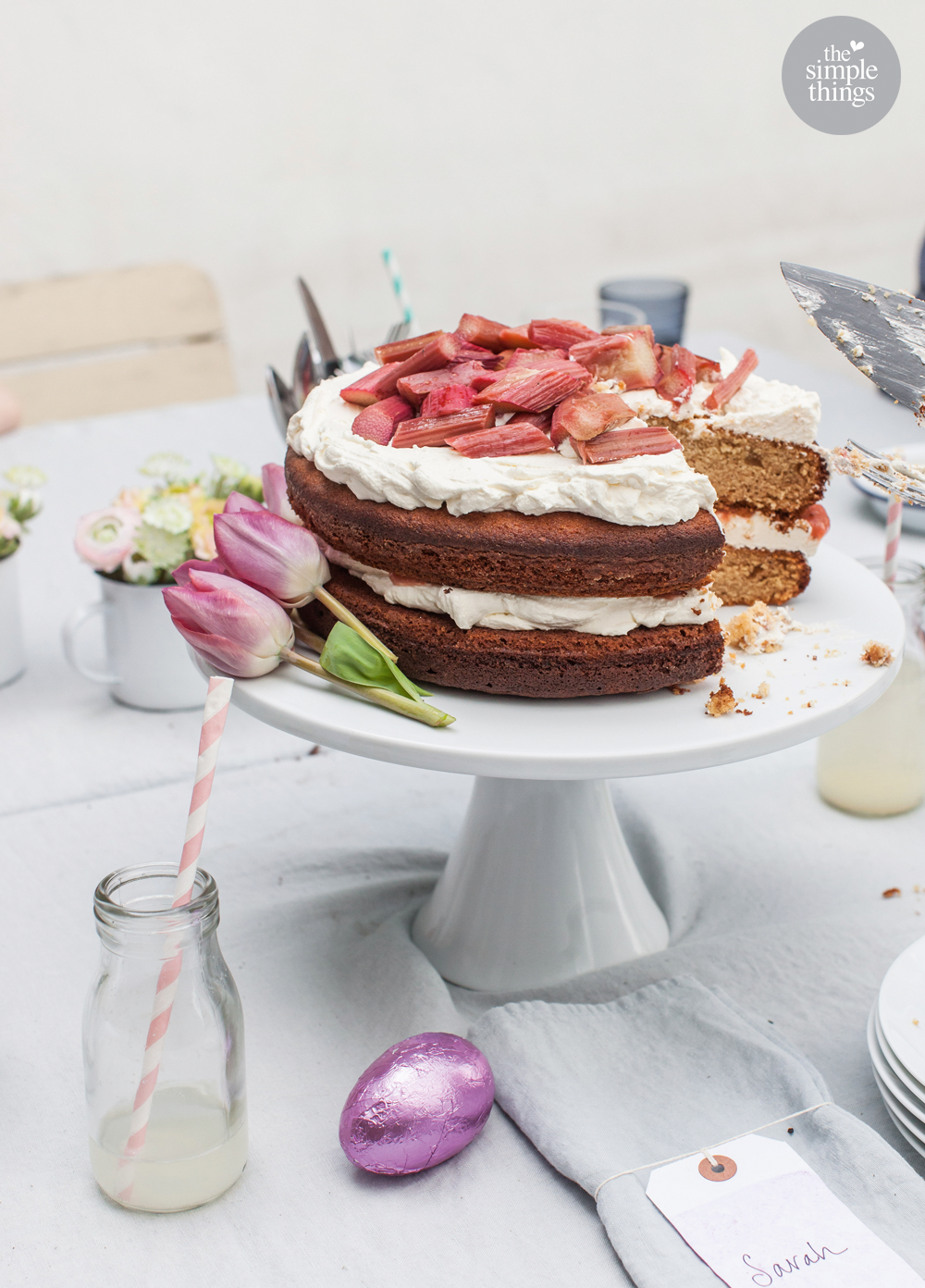
This crowd-pleaser of a cake is delicious served with cream for dessert and (if there’s any left!) with an afternoon cuppa the next day
Serves 8–10
115g hazelnuts
225g white spelt flour
2 tsp baking powder
260g unsalted butter, really soft
4 large free-range eggs
130g honey (or golden caster sugar)
130g maple syrup
finely grated zest of 1 large unwaxed lemon
For the filling and topping
250g caster sugar
1 bunch of pink rhubarb (approx 400g)
350ml double cream
2-3 tbsp honey
fresh flowers to decorate (optional)
1 Preheat the oven to 180C/Fan 160C/350F. Grease and flour two 20cm loose-bottomed sandwich tins.
2 Start by toasting the hazelnuts in the oven for 5-7 minutes; check after 5 minutes as they can burn easily. Once they are starting to change colour and release their lovely nutty aroma, remove them from the oven and leave to cool for a minute or two before rubbing off most of the skins. Whizz the nuts in a food processor into a fine meal.
3 To make the cake, sift the flour and baking powder into a large bowl and beat in all the other ingredients using an electric hand mixer. Be careful not to over mix – you want a light cake. Scrape the mixture into your tins and level the tops with the back of a spoon or a palette knife. Bake for 25-30 minutes, or until the cakes are golden and risen and a skewer inserted into the centres comes out clean. Remove from the oven and leave to cool for 5 minutes before carefully taking them out of their tins and placing on a cooling rack to cool completely. If making ahead of time, the sponges can be double-wrapped in foil and frozen. Be sure to defrost thoroughly before filling.
4 To make the rhubarb topping, mix the caster sugar with 250ml of water in a saucepan and bring to the boil. Meanwhile, cut the rhubarb into batons of approx 4cm. Add the batons to the boiling sugar syrup, then immediately remove the pan from the heat. Leave the rhubarb batons in the syrup as it cools. Use a slotted spoon to remove the batons from the syrup. Reserve approx half for the top of the cake and purée the remainder with a hand-held blender, adding a splash of water to loosen. Chill the poached and puréed rhubarb until you’re ready to assemble the cake. If making ahead of time, the rhubarb can sit covered in the fridge for 24 hours.
5 When you are ready to fill and assemble your cake, prepare the honey cream filling by lightly whipping the cream until very soft peaks form. Drizzle in the honey and whisk again until incorporated.
6 If your cakes are very peaked, you may wish to trim the tops for a nice flat surface to decorate. Carefully place one cake on your cake plate, spoon over two thirds of the honey cream, marbling through 1-2 tbsp of the rhubarb purée, and place the second cake on top. Spread the remaining third of honey cream on the top of the second cake, then top with the poached rhubarb and a few seasonal flowers, if you wish.
For the full Easter Gathering menu and projects - Fish pie with crunchy salmon and leek topping, Lemon, hazelnut and rhubarb cake, Felt bunny ears, Dip-dyed place-names - turn to page 24 of the March issue of The Simple Things.
Illustration: Joe Snow
This deeply cleansing face mask is a chocolate lover’s dream. It smells divine, too – almost good enough to eat...
MAKES: almost 250ml
KEEPS: up to six months in a jar
INGREDIENTS:
11⁄2 tbsp raw cocoa powder
1 tbsp white kaolin powder
10g dried peppermint leaves
40–60ml coconut oil
METHOD
1 Mix the dry ingredients together.
2 Gradually add the oil until you have a thick paste.
3 Apply to cleansed skin and then leave on for 15–20 mins.
4 Wash off well and moisturise.
Found in The Domestic Alchemist: 501 Herbal Recipes for Home, Health and Happiness by Pip Waller (Leaping Hare Press). Recipe courtesy of Teri Evans.
Inspired by our workspace feature in the February issue, our Stuff of Life shopkeeper, Louise Gorrod, has taken a screenbreak to bring you her pick of workspace products.
From space-saving bookshelves and seating to decorative notebooks for all those ‘To-Do’ lists, The Stuff of Life will make your 9 to 5 run more smoothly.
Images from top, left to right: In Flight Print by Quince Living, £26.00 | Fläpps Shelf by Ambivalenz, from £119.23 | Jungle Fever Notebook by Kith & Kin, £3.50 | Gold Wall Clock by Home Address, from £75.00| Mini Book Rack by Agustav, from £75.00 | Memo Card & Envelope by Alfie’s Studio, £1.50 | Fläpps Folding Chair by Ambivalenz, from £173.08 | Recycled Pickle Jar Light by Cachette, £42.31 | Concrete Holder by Cachette, £20.00.
If you like your spring weekends bright and breezy, fresh and clean, full of fun and flowers, then you’re in the right place. First, let’s start the day right with eggs – fresh, baked or chocolate? We’ll peg out the laundry, pop on a pair of loafers or some cool trainers and take the dog for a walk, stopping to admire the blossom as we explore the neighbourhood. There’ll be time for tea, with something from the biscuit tin, and to find a quiet spot with the crossword before a long family lunch and Easter games. Share the moment with us, share The Simple Things
The March issue of The Simple Things is out today - buy, download or subscribe
View the sampler here
Photography: Kirstie Young
Eggs are a symbol of new life and, eaten with handfuls of bright green sorrel, bring a little colour and sustenance to early spring days
Sharp and lemony sorrel is plentiful now, and it is wonderful in egg dishes. Try it in Lia Leendertz's Eggs en cocotte recipe.
Serves 2
butter, for greasing
75g crème fraîche
4 sorrel leaves, washed and finely sliced across
2 large eggs
salt and pepper
1 Preheat the oven to 180C/Fan 160/350F.
2 Lightly butter four ramekins, then put a spoonful of crème fraîche in the bottom of each, with a pinch of salt and pepper and the sorrel, making a ‘nest’ to hold the egg.
3 Crack an egg into each ramekin, then place another spoonful of crème fraîche in, and add another sprinkling of salt and pepper.
4 Place the ramekins into a deep baking dish and pour in enough boiling water to come about half way up their sides. Bake for about 15 mins.
5 Serve with toasted soldiers for dipping.
Illustrations: VICKI TURNER
Baked, boiled, poached, fried or scrambled, this healthy favourite is an everyday treasure, as sure as eggs is eggs
Words: LAURA ROWE
The humble hen’s egg is one of the most readily available, cheap and endlessly versatile food stuffs around, but did you know that it is also one of the most ancient? Us humans have been eating all things ovoid since the Neolithic period, chomping our way through varieties of fowl egg from chickens, geese, quail, pheasant, plovers and guinea fowl, to ostriches, emu, pelican, pigeon and gull (the latter is without a fishy taste, apparently, contrary to rumour).
It’s little wonder, really. The egg is nature’s perfectly packaged hand-held, bite- size snack. It’s packed with vitamins (A, B, D and E) minerals (iodine, phosphorous, selenium, zinc and iron) and it’s a ‘complete’ protein, meaning that it has all of the essential amino acids that our bodies need. Eggs are also a cook’s friend – delicious in sweet or savoury dishes, whole or separated, on their own or as a component ingredient to bind, set, leaven, thicken, enrich, emulsify, glaze or clarify.
They can be boiled (older eggs are best here, as they are easier to peel), scrambled with butter (slow and low), poached (whisk the water to create a vortex before you crack in a fresh egg) or fried (butter and oil are good but bacon fat is better). They can also be baked (see page 43), or ‘shirred’, as the Americans call it, with cream and topped with cheese and breadcrumbs.
Whatever you do to them, they are best approached at room temperature, particularly in baking. You can check just how fresh they are, too, by placing them carefully in a glass of water. If they sink to the bottom they are good to go, while a floater can be discarded, that is unless you’re in China. Thousand-year-eggs are a delicacy here. Preserved in a combination of salt, lime and ashes, the egg is left for 45 to 100 days, whereupon the white turns yellow, firm and raw, presumably eaten with noses firmly pinched thanks to the strong smell of ammonia.
That’s far from the most unusual way to eat eggs, though. Head to South East Asia, specifically the Philippines or Vietnam, and you might stumble across a balut – a boiled, fertilised 17-20 day-old duck egg.
Extract from Taste: The Infographic Book of Food by Laura Rowe, illustrations by Vicki Turner by Aurum Press, £20. Buy your copy here.
Illustration: Joe Snow
It doesn’t need blood, sweat or tears. Unlike deciding what to write
Ink is pigment mixed with a carrier, such as water, and something to help it stick to paper – 1 tsp gum arabic. Kitchens are full of pigment possibilities – try these out. Wear gloves!
BLACK: Mix gum arabic, an egg yolk and 100ml honey. Stir in 1⁄2 tsp of lamp black (the soot created when a plate – or similar – is held over a flame).
DARK BROWN: Cover 6 to 8 whole blackened walnuts with water and simmer for up to an hour. Strain through muslin, before mixing with water, gum arabic and vinegar.
BROWN: Pour boiling water over 5 tea bags and steep for around 15 minutes. Squeeze bags. Add gum arabic to the liquid and strain through muslin.
BLUE: Simmer two handfuls of elderberries in vinegar. Squish, strain and mix with gum arabic.
Store your inks in lidded jars. They’ll work best with traditional dip pens.
We celebrate slowing down, enjoying what you have, making the most of where you live, enjoying the company of of friends and family, and feeding them well. We like to grow some of our own vegetables, visit local markets, rummage for vintage finds, and decorate our home with the plunder. We love being outdoors and enjoy the satisfaction that comes with a job well done.