Grab your cossie, we’re going for a dip
Listen to more playlists:
Featured
Blog
Taking Time to Live Well
Grab your cossie, we’re going for a dip
There are plenty of local courses online, or look at those run by the National Trust (nationaltrust.org.uk/build-your-skills). Wild guides (wildthingspublishing.com) also list local courses by region.
Try your hand at carving anything from spoons to stools. From £65, woodmatters.org.uk.
All-female day and weekend retreats in Tortworth Arboretum, eg, willow skills and campfire cooking. From £16.50, honeywoodscamping.co.uk.
Women-only wilderness weekenders include foraging, wild medicinal plants and natural navigation. From £160, wild-things.org.uk.
You’ll use 100% recycled materials to forge your own knife, complete with an antler handle. Four-day course, from £350, wildbushcraft.co.uk.
Craft courses are run throughout the year in Ecclesall Woods in Sheffield. From blacksmithing to furniture- making, the bustling Woodland Discovery Centre is a hidden oasis in the city. From £85, ecclesallwoodscraftcourses.co.uk.
Most come with a stake to sink into your borders thus creating a row of lights to guide your eye (and guests) along the garden path. Try: Solar bubble outdoor stake lights, £24 for four (johnlewis.com), which change colour and add a little festival flavour to proceedings.
Bigger and brighter than fairy lights with round bulbs best hung in swags. They look good strung from trees or a pergola and provide enough light to eat by. Try: Elan solar festoon lanterns, 20 LEDs, £19.98, thesolarcentre.co.uk; LED connectable perspex festoon lights, £35, lights4fun.co.uk.
Garden torches with LED lights exist but are tame compared to the guttering flame of an oil lamp. Try: Iron garden torches, £15.95 each; 120cm high (allthingsbrightonbeautiful.co.uk); bamboo garden torches, £5.90 each; 180cm high (homebase.co.uk).
Created to withstand storms at sea, these robust lamps are fuelled with paraffin with a wind-up wick, and won’t blow out. Put one or two on the table or hang from wall hooks. Look out for them at army surplus stores. Try: Silver hurricane lantern, 10 inch, £5.99 (surplusoutdoors.com).
Photography: Alamy
Forests can often feel a little like galleries: the hushed atmosphere, the filtered light, the sculptural forms of the branches. It’s no surprise then that several forests have taken this one step further, installing site-specific sculptures, to help us explore and understand the woods and their history. So in the Forest of Dean Sculpture Trail, lines of compressed charcoal by Onya McCausland signal underground coal mines, while in Kielder Water and Forest Park in Northumberland, Chris Drury’s Wave Chamber projects the rippling waters of the adjacent lake onto the chamber’s floor.
Summer is often when we head to the coast and, just as many of our seaside towns are now home to impressive art galleries (think Margate and Dundee), so outdoor art has stepped into the limelight. Another Place by Antony Gormley is undoubtedly one of the most haunting works: 100 life-size cast-iron statues “trying to remain standing, trying to breathe,”as Gormley has said, in the shifting sands of Crosby Beach, just north of Liverpool. Due to its size, and therefore the statement it makes, a lot of outdoor art tends to be by well known artists with guaranteed ‘pulling power’ (eg, Maggi Hambling’s Scallop at Aldeburgh). It’s refreshing then to note that the five new waymarking sculptures created for the Gower coastal trail between Mumbles and Rhossili this year are all by lesser-known artists, all women, handcarving in oak.
Purpose-built sculpture parks got going in Britain in the late 1970s with the launch of the Yorkshire Sculpture Park, the first in the UK and, with more than 500 acres to play with, the largest of its kind in Europe. The rolling open fields provide an expansive backdrop to monumental pieces by Henry Moore, while the landscaped grounds and woods shelter works by a roll call of leading names from Elisabeth Frink to Andy Goldsworthy. Entrance is free, but donations are invited. If it’s site-specific art you’re after, head further north to Jupiter Artland, just outside Edinburgh, where collectors Robert and Nicky Wilson have invited contemporary artists to make new pieces for their 100-acre estate. Highlights include several works by Goldsworthy and Cells of Life by Charles Jencks, in which the earth itself has been sculpted into sinuous, swirling landforms.
Turn to page 64 of July's The Simple Things for more extraordinary and challenging, joyful outdoor art that helps us see the world differently.
For the first time this year, schools around the country are getting the chance to show off their gardening skills with the launch of Schools Allotment Week.
From 16th to 22nd July, The National Allotment Society will be celebrating schools in the UK who have an impressive allotment plot on an allotment site or in their school grounds. In particular, they’ll be looking for schools with a range of crops, ones who use the produce they grow and also that consider bio-diversity and the role of predator and pollinators on their allotment.
One winning school will be revealed during the Week itself, with a trophy and plaque awarded along with gardening seeds and £250 of gardening vouchers from Nature’s Path.
Nature’s Path, the organic and gluten-free cereal pioneer, is a champion of the outdoors. Its guiding ethos is ‘Always leave the earth better than you found it’, something that’s shared by anyone with a love of gardening.
The company’s commitment to the environment is rooted in sustainability and it is an active supporter of community and urban gardening initiatives. It also maintains a large garden at its HQ – with produce distributed amongst its staff.
As such, the family firm is proud to be supporting Schools Allotment Week. In fact, it actively encourages the education of kids and families about the environment and our planet. 1% of the revenues of its Envirokidz cereal is given to nominated animal charities who are working hard to save endangered animals, protect their habitats and educate kids worldwide. Schools Allotment Week is another important campaign that can teach our future generations about the value of taking care of the environment around us.
As well as Schools Allotment Week, Nature’s Path is this year supporting National Allotment week on 13th to 19th August. This year’s theme is ‘Living and Growing’. It highlights the importance of allotments and of growing your own food and incorporating fruit and vegetable gardening into your lives.
For further information on Schools Allotment Week and National Allotment Week visit https://www.nsalg.org.uk/news-events-campaigns/schools-allotment-week-16-22-july-2018/
For further details on Nature’s Path visit www.naturespath.co.uk
Illustration: ALICE PATTULLO
With its protruding spines, downward gaze and prehensile tail, this most beguiling fish looks like a shy, prehistoric ghost. Floating upright, it hangs motionless waiting for its prey to pass, which it then sucks up through its long snout. Found in seagrass habitats from Scotland to Dorset.
Most often seen when masses, known as a ‘bloom’, are washed up on the beach. Which is a shame, as they look most beautiful floating in transparent clusters. Moon jellyfish can grow up to 40cm in diameter and have short hairy tentacles that hang from their dome like a fringe. They are mostly harmless, though may sting sensitive skin.
This elegant starfish has long slender arms which they can cleverly self-amputate if being attacked; the arms regrow. Brittle stars prefer to live in great gangs (called ‘aggregations’) on the sea bed, their arms raised to catch plankton; can number up to 1,500 per square metre. Usually in deep water but sometimes under boulders and in rockpools.
Unlike other anemones, Snakelocks anemone’s bright-green tentacles remain out all the time: all the better to sting and capture small fish. They can be found on the seabed, attached to large seaweeds, and in sunny rockpools, where their flowing tentacles with their purple tips sift through the passing currents.
Attached to rocks and other objects by a long black penduncle and with a chalky white shell which opens to reveal spiky fronds, this unusual creature has an alien-like quality.
Often disguised by seaweed and sponges that grow all over it, this large knobbly crustacean has long-jointed legs, small claws and spiky shell. It can be found in South and West England and its sustainable numbers mean it’s increasingly eaten in the UK, although most are exported to France and Spain.
Photography: John Kernick
FOR EACH PARCEL
3 sprigs flat-leaf parsley
1 large sprig fresh rosemary or thyme
3 spring onions, finely chopped
1 tbsp extra virgin olive oil
2 tbsp lemon juice or a splash of dry white wine
250g shellfish, such as cockles, clams and prawns (with shells on)*
1 Take a large 30cm square of baking parchment for each parcel. On one side, place your mixed herbs and spring onions, season and drizzle with a little oil and lemon juice or wine. Lay the shellfish on top, drizzle over the remaining oil and lemon juice.
2 Fold the paper up and over the filling, and pinch all the way round to secure, tucking the corners under a couple of times to ensure the parcel is thoroughly sealed while leaving plenty of space in the parcel for air to circulate evenly during cooking. If you’re barbecuing them, wrap a sheet of foil around the parcel too, taking care not to squash it.
3 To barbecue: ensure the charcoal grill is medium hot (your hand over the coals should be comfortable for about five seconds). Place the parcels on a grill rack and cook for 3–4 mins until you start to hear the juices bubbling. Cook for another 5 mins with the lid over the barbecue. Take off the heat and set aside, unopened, for 5 mins.
4 To cook in the oven: preheat to 200C/ Fan 180C/Gas 6, place the parcels on a baking tray and cook for 20 mins. Take out and check the cockles or clams have opened or prawns are bright pink. Remember it will continue to cook when out of the oven. Stand for 3–5 mins.
Recipe from Mediterranean by Susie Theodorou (Kyle Books).
* You can replace the shellfish with 175g fish such as sea bass, mackerel or salmon (about 1.5cm thick, keep skin on). Cook until fish is just flaky.
A day spent learning a new skill is mindful and mind full (in a good way) living. This month, Kate Pettifer learns sea kayaking.
A pond off the A10 is where I learnt to canoe. It involved a minibus and changing out of school uniform, so it was a while ago. The idea of getting out to sea on a kayak, in Dorset’s beautiful Studland Bay, is all the temptation I need to try it again.
I’m on a three-hour taster session: we kit up at the hut, then it’s down to the beach to practise our paddling, sitting on the sand, wearing wetsuits, helmets and spraydeck skirts. As you do. Josh, our instructor, runs through the basics. In touring kayaks, we head across the bay towards Old Harry Rocks to practise going forwards, backwards, left and right. No swimmers are harmed, no boats bashed – I take this as a success.
Then – joy of joy – we’re out of the wind and alongside the chalky cliffs, paddling serenely through mirror- calm shallows, a colourful garden of seaweed swaying just centimetres below in the bathwater-clear sea.
We paddle onto a pebble beach, only accessible by boat. Josh talks a bit about the geography and nature of the area. We sample pepper dulse, a feathery purple seaweed with a buttery-then-fiery taste. Then it’s back in the canoes to manoeuvre through a gap in the rocks, into open water, to see Old Harry himself. Paddling under an arch in the cliffs is a real highlight, before we set off back.
It’s a fairly strenuous couple of hours – sitting upright, bracing your legs, and paddling, of course. But touring kayaks lend themselves to slow and steady handling, so there’s no pressure to bomb along. More than exercise, though, it feels like a privilege to visit such a picturesque spot from sea level, enjoying the clear waters and the peace that bobbing around on the sea can bring.
A three-hour sea kayaking taster with Fore/Adventure costs £60; foreadventure.co.uk.
Illustration: Kavel Rafferty
Anaphylactic shock is possible from jellyfish stings. Seek immediate medical attention if any of the symptoms of an allergic reaction: nausea, difficulty in breathing, difficulty in swallowing, fever, heart palpitations.
WHILE YOU WAIT FOR MEDICAL HELP:
* Prevent further stinging by brushing away tentacle fragments.
* Scrape off any remaining stinging cells with a sharp-edged object such as a credit card. A towel will suffice if nothing else is available.
* Rinse with seawater, not ever with fresh water (which can trigger further stings).
* Apply up to five drops of lavender essential oil to help neutralise the sting. Reapply every 15 minutes. (Pouring urine on the stung area has the same effect.)
* Start healing. Apply vitamin E or aloe vera juice to heal tissue and reduce inflammation.
Adapted from The Natural First Aid Handbook by Brigitte Mars (Storey Publishing).
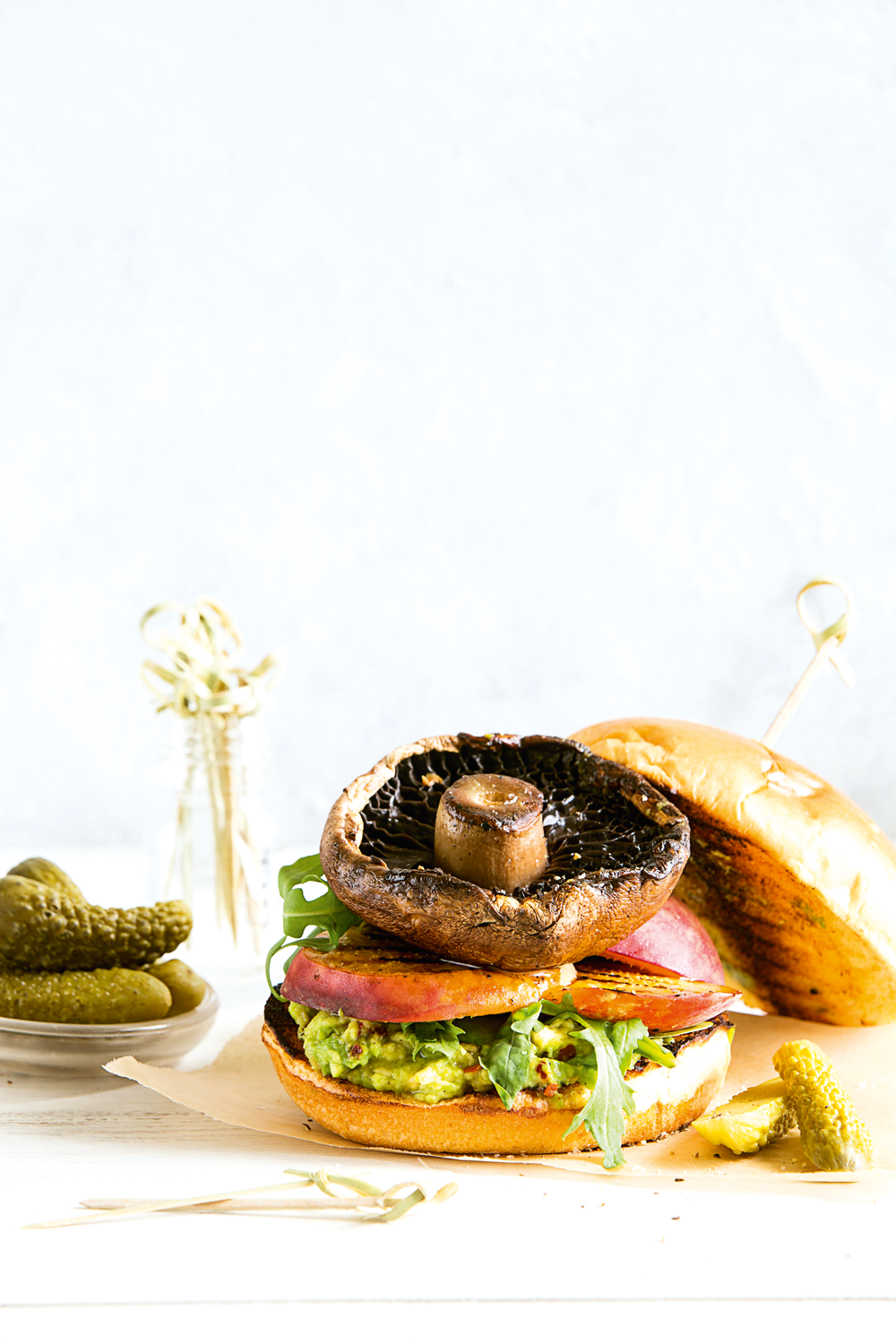
Guacamole takes this veggie burger to another level
Makes 6
6 portobello mushrooms
2 tbsp olive oil
3–4 peaches, sliced so you have two slices per burger
6 brioche buns
Rocket leaves, to garnish
Gherkins (optional)
FOR THE GUACAMOLE
2 avocados, peeled, stone removed and cut into chunks
Juice of 1⁄2 lime
1⁄2 red onion, finely chopped
Chilli flakes, to taste
1 Brush the mushrooms with a little olive oil and season with salt and black pepper. Add to the barbecue and cook for 3–5 mins each side.
2 Brush the peach slices with a little oil and cook for 2–3 mins each side. Slice the brioche buns and place cut side-down on the barbecue for 1–2 mins, until browned.
3 Mash the avocado roughly with a fork. Add the lime juice, onion and chilli flakes. Mix together.
4 Add a layer of guacamole to each bun base, followed by the rocket leaves and two peach slices. Top each with a mushroom, add gherkins, if using, and sandwich with the bun tops. Use a bamboo skewer to keep assembled burgers in place.
Turn to page 24 of the July issue for more of our veg box barbecue ideas, including Halloumi & courgette parcels, Quinoa salad with new potatoes, tomatoes, edamame & nectarines, Vegetarian skewers with a lime & honey dressing and Watermelon triangles.
AS SPRING ARRIVED we produced a set of four sew-on badges (you can buy them, see page 23 of July's The Simple Things), each reflecting an everyday action that can enrich your life. The first four were on the themes of be active, connect, keep learning and take notice.
We asked readers to design the fifth Happiness Patch, in the style of our series, on the theme of give. And you rose to the task – we had over a hundred patch designs submitted
The winning design ‘Share with Others’ (above) by Lauren Bowers is being made into a real patch and she wins a fantastic VIP glamping festival package with The Good Life Experience (thegoodlifeexperience.co.uk).
All good things come to those who wait and, if you’re a subscriber, the wait will be worth it, as we’ll be sending you one of Lauren’s patches with your September edition of The Simple Things.
We’ll also be selling the ‘Share with Others’ patch online from the end of August and donating all the proceeds to The Trussell Trust, which works to end hunger and poverty in the UK by co-ordinating a 420-strong network of foodbanks, and now provides money advice and fuel banks, too. Some 13 million people live below the poverty line in Britain and the number is growing each year.
Subscribe before 13 August 2018 to receive a free ‘share with others’ patch.
Things you might want to do this month (no pressure!)
What would you add? Come over and tell us on Facebook or Twitter.
With its tangle of spiky foliage, Nigella (Love-in-a-Mist) is the quintessential cottage garden plant. “Nigella lends itself well to meadow- style jar arrangements, small posies and wedding bouquets,” says Ellie Marlow, florist at Catkin & Pussywillow. “The dried seed pod is beautiful, too, and looks great matched with autumn colours when summer has passed.”
Illustration: Kavel Rafferty
“When you wish upon a star, your dreams come true.” Why, other than the reassurances from Jiminy Cricket, do we believe this? It’s an idea that spans cultures from all over the world. But even thinking of them as stars is wishful thinking – in fact they’re meteors going all ablaze entering Earth’s atmosphere.
Back in the 2nd century, Greek astronomer Ptolemy interpreted them as a sign the Gods were peering down at Earth – the stars slipped through spaces in the heavens – and therefore a good time to ask for what you most wish. It’s more likely their hold comes from their rarity, making a spotter feel blessed. Be thankful you only need to make a wish upon spotting.
In Chile, you’re also required to pick up a stone to make your wish, while in the Philippines you have to tie a knot in your hankie before its light goes. Good luck with that!
Photography: Tony Briscoe
100g dark chocolate
390g jar black cherries in kirsch or 400g tin black cherries in syrup*
250g black cherry conserve or jam
600ml double cream
85g meringue nests (5–6)
TO SERVE
Fresh cherries (with stalks)
A handful chopped pistachios
Icing sugar, to dust
1 Line the base of a 23–24cm springform tin with a square piece of baking paper, leaving the excess sticking out from the sides.
2 Melt the chocolate in a small bowl suspended over a pan of boiling water. Drain the cherries in a sieve set over a small pan, and set aside the kirsch or syrup.
3 With a food mixer, roughly blitz the cherries into a chunky, textured pulp. Stir the conserve or jam in a small bowl to loosen.
4 In a food mixer or large mixing bowl, whip the cream until just beginning to thicken and barely holding its shape – the trick is to under-whip. Pour in the conserve or jam, followed by the meringues, breaking and crumbling into irregular shapes and sizes as you go. Fold into the cream very gently, leaving a ripple effect.
5 Spread a scant third of the mixture into the tin. Top with all the blitzed cherries by spooning on in blobs, then joining the blobs.
* If you’re using tinned cherries, 1 tbsp of cherry brandy of amaretto is a nice addition when reducing the syrup.
Spread over half of the remaining cream using the same technique.
6 Dribble over all but 2–3 tbsp of the chocolate and spread to cover the cream. Finally, blob and spread over the last of the cream. Using a spatula or the back of a spoon, gently push the mixture into the tin to get rid of air pockets.
7 Cover with cling film, directly on the surface of the cake, and freeze until solid (overnight is best).
8 Boil the reserved cherry liquid fast until syrupy and reduced to around 2 tbsp. It will thicken up when cold and, if too thick when cold, loosen with a drop of boiling water.
9 Serve the cake straight from the freezer. Unmould onto a large platter. Warm the set-aside tbsps of chocolate and drizzle from a teaspoon, zigzagging over the cake and platter; repeat with some of the syrup.
Pile the fresh cherries in the middle, scatter with chopped pistachios and dust with icing sugar.
Recipe from The Get-Ahead Cook by Jane Lovett (Apicius Publishing).
Cake in the House is our monthly recipe feature - get a cake recipe every month in The Simple Things!
Not everyone likes surprises, but we can all appreciate a new discovery. It might mean visiting
a new city or opening your eyes to outdoor art but simpler pleasures too, like trying a new author or an all-veggie barbecue. There are also unexpected treasures to seek out within yourself; hone your sixth sense, learn outdoor skills, become a more mindful gardener. You could start this voyage by taking every meal you can outdoors, then watch and wait as nature creates patterns before your very eyes. A month of adventure awaits.
Get hold of your copy of this month's The Simple Things - buy, download or subscribe.
View the sampler here, buy back issues or try our sister mag, Oh Comely
The towering spikes of delphiniums (aka larkspur), at their best in June, make ideal cut flowers. Easy to look after, they will last for up to seven days in a vase.
“They are best displayed en masse in a tall vase,” says Ellie Marlow, florist at Catkin & Pussywillow. “Or with other strong blooms like hydrangea or peonies for a gorgeous summery bunch.”
Summer hasn’t really arrived until you’ve worn your sandals for at least three days in a row. Those odd days when you optimistically whip them out only to have regrettably chilly toes by evening don’t count. The constant wearing of sandals is a surer indicator of summer than the arrival of the first swallow.
Like autumn boots and winter coats, sandals are a key seasonal item. As such, they benefit from a refresh each year: slipping freshly pedicured feet into a brand new pair will put a bounce in anybody’s step. (Providing they don’t rub, of course.) As with any other item of clothing, however, sandals are subject to the vagaries of fashion. We’ve all padded around in Birkenstocks and clopped about in wooden-soled Hasbeens. And which one of us hasn’t got a pair of gladiators, all leather straps and buckles, tucked away at the back of the wardrobe? Salt-water sandals, originally developed for post-war American children in the 1940s from leather scraps, have been the sandal de choix for the past couple of years, and show no sign of disappearing. Neither, unfortunately, do Crocs.
The popularity of flat sandals (high-heeled versions are also available, but do not concern us here) is due to the simple fact that they suit hot weather. By leaving most of the foot exposed, they keep it cool and dry. Feet confined by leather and without ventilation run the risk of Athlete’s Foot or simply becoming unbearably hot. Which is why sandals have always been with us – a pair discovered in Oregon, America, were estimated to be 10,000 years old, the earliest recorded footwear. It is why they were appreciated by Ancient Greeks of high rank who fashioned sandals from willow leaves that fastened up the leg, and by the Ancient Egyptians whose secured theirs with palm leaves and papyrus.
The only downside to wearing a pair of sandals is the state of the feet within. There is nowhere to hide calloused or grubby feet, and wearing socks with sandals although fashionable, is still best avoided. Fortunately, a cheery nail polish combined with a stylish sandal will distract most eyes away from any foot flaws. Nothing should come between you and summer’s essential shoe.
A quick veggie supper after a day by the sea; marsh samphire can be foraged or bought locally in summer.
It grows on muddy, sandy flats often on estuaries or creeks. Simply pinch out or snip off the tops to leave the rest of the plant to grow. Samphire is usually served with fish but also goes beautifully with eggs.
Serves 4
FOR THE COURGETTE SALAD
150g runner beans, sliced on the diagonal
3 tbsp olive oil
Shallots, sliced
Yellow courgettes (or green if you can’t find them), halved and cut into chunky slices
2 garlic cloves, finely chopped
6 small vine-ripened tomatoes, halved or quartered if large
2 rounded tbsp chopped oregano leaves
Juice of 1⁄2 lemon
FOR THE FRITTATA
250g new potatoes, sliced
2 tbsp sunflower oil
6 large eggs, beaten
50g samphire
Handful of tarragon, leaves finely shredded
100g soft goats’ cheese
1 To make the courgette salad, steam the runner beans for 5 mins or until tender. Refresh the beans under cold running water and put to one side.
2 Meanwhile, heat 2 tbsp of the olive oil in a frying pan over a medium heat and cook the shallots for 5 mins until softened. Add the courgettes and garlic, and fry for 3 mins. Stir in the tomatoes, half the oregano and the lemon juice, then reduce the heat slightly and cook
for 5 mins or until the courgettes are just tender but retain a little bite, and the tomatoes have started to break down.
3 Stir in the runner beans, add the remaining olive oil, and season with salt and pepper, then warm through. Keep the salad warm while you make the frittata.
4 Put the potatoes in a pan of cold salted water and bring to the boil. Cook for 15 mins or until tender, then drain in a colander.
5 Heat the sunflower oil in an ovenproof frying pan. Add the drained potatoes, and the
beaten eggs, most of the samphire and the tarragon. Lay the remaining samphire elegantly on the top. Crumble over the goats’ cheese and season with salt and pepper (remembering the salty flavour of the samphire, so you won’t need much salt).
6 Preheat your grill. Cook the frittata for 7–10 mins on the hob over a medium heat, enough to set the bottom, then finish under the grill until just set all the way through. Add the remaining oregano leaves to the salad and serve it warm with the frittata.
We celebrate slowing down, enjoying what you have, making the most of where you live, enjoying the company of of friends and family, and feeding them well. We like to grow some of our own vegetables, visit local markets, rummage for vintage finds, and decorate our home with the plunder. We love being outdoors and enjoy the satisfaction that comes with a job well done.