If you fancy yourself as Little Bo Peep… you might want to have a career rethink. Here are some of the skills and characteristics you need to become a shepherd
1. High tolerance for bad weather
Could you dig an animal out of the snow in minus 40-degree wind chill? Carry sodden bales of hay miles across fields in driving rain? Or cope with shearing a wriggling sheep in 35-degree heat? Sheep never stop so you need to be ‘outdoorsy’ to say the least. If you’re already a bit weather-beaten, so much the better.
2. Speed and agility
Most jobs as a shepherd begin ‘first catch your sheep’ so you’d better be fast. Chase it into a catch pen first, or you will find yourself dashing comically around a field and possibly drawing an amused crowd. Once in a small pen, the job is easier as there’s nowhere much for the sheep to go. Cup one hand around the sheep’s jaw and place the other on its neck. If a sheep has its head up it’s easier to control. You can grab a back leg to help you get a purchase on its head if you need to. A shepherd’s crook can be used if you need a longer ‘reach’. We were surprised too! Turns out they’re not just used in panto!
3. Excellent observation skills
One of the main tools a shepherd has for managing her flock is known as Body Condition Scoring. It means looking at an animal and being able to size up its health and nutritional status, but it’s much more than a visual check. Most of the information is gleaned by rubbing your hands along the backbone, ribs and loin to feel for fat and muscle. A bit like a pat-down at the airport. But woolier. And more aggressive.
4. Not being scared to be hands on
If you thought the Body Condition Scoring was a bit personal, wait till they tell you what other jobs you might have to get hands on with. But first you have to get the animal into a compliant position by ‘tipping’ her. You start with the sheep in a standing position, then put her on her rump. From there, jobs like giving vaccines and ear tagging are a lot easier. NOT ‘easy’, we hasten to add. Just less terrible.
5. A strong stomach
Sheep poo really is the least of your worries. Once you have tied string around a womb prolapse bare-handed you’ll feel differently about a) your lunch. And b) other nasty jobs like unblocking a drain.
6. Patience. Lots of it
Like the Supremes said, you can’t hurry sheep. OK, that was ‘love’ but the principle is the same. Sheep work on their own timeframe, particularly during lambing season. You will spend many hours standing in a field, but even on days when nothing much is happening, you learn so much from standing in that field. Watching your sheep is how you get to know them and know what their ‘normal’ is, so it’s always time well spent. If you’re the sort of person who works to a timetable, don’t work with sheep.
7. A big heart and also a hard heart
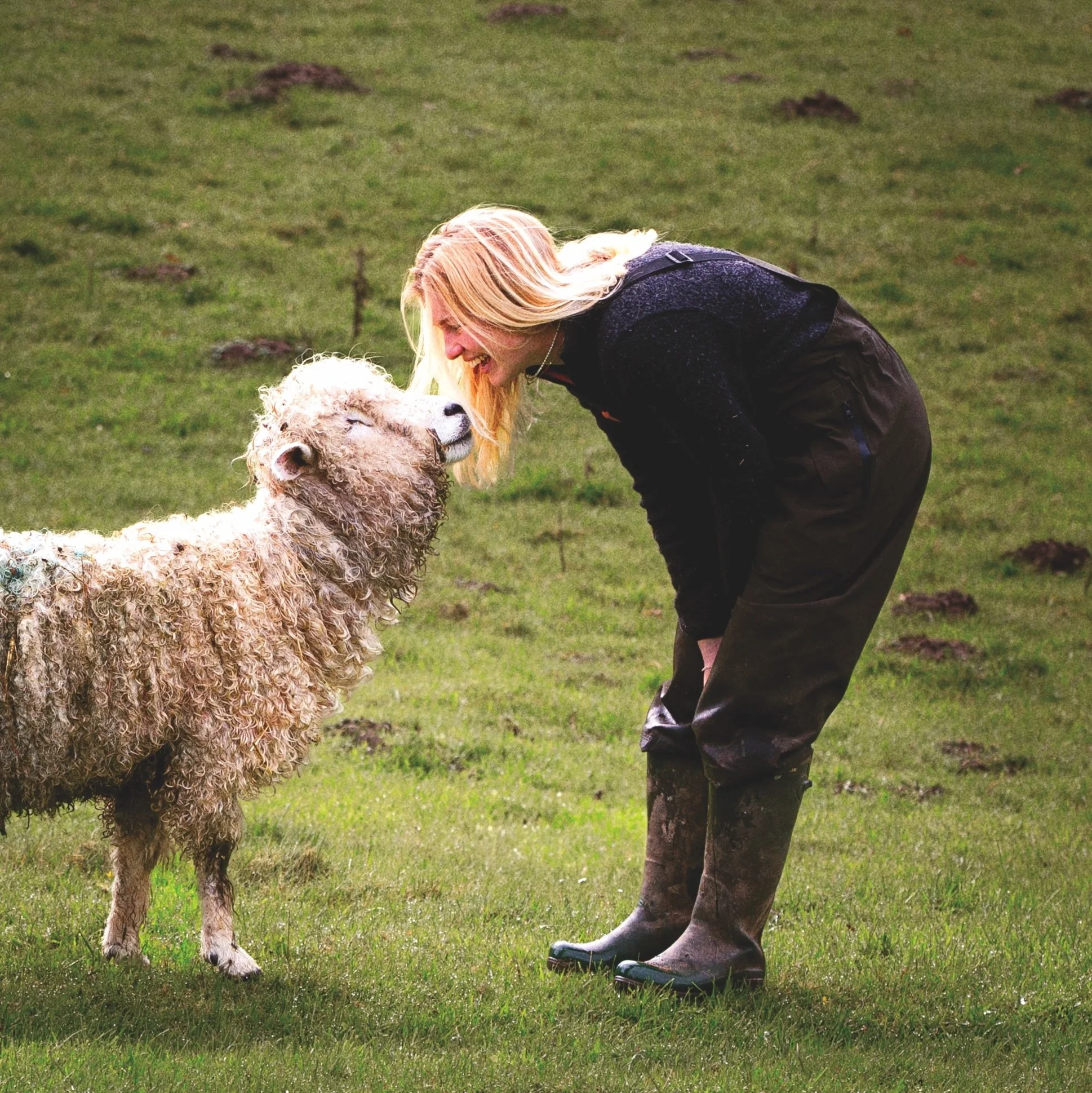
To handle sheep you need to love them, each and every one of them, for their funny ways and quirky personalities. By the time you’ve stayed up all night with them in a hail storm because they’re ill, sat with them while they laboured bravely in lambing season, and teared up as you’ve seen their babies into the world, you’ll love them like your own children. And then you need to know when it’s time to call the vet one day and say goodbye as they are seen off over the woolly rainbow. And after that you just have to pick yourself up and get on with the next job. Because there are more sheep that need you and will break your heart into pieces all over again.
In our November issue we meet some of the artisans from Dartmoor, including a pair of rare-breed sheep farmers, Flora and Lewis. Turn to page 78 to read all about them.